


What’s in Your Bucket? Balancing Demand and Capacity


You’ve probably seen some version of this bucket diagram for project demand versus resource capacity.
When the faucet labeled Demand overflows the bucket labeled Capacity, the logic seems simple: either get more buckets (add capacity) or turn down the faucet (reduce demand). In other words, raise the bridge or lower the river.
But it’s not that simple, is it? That picture hides one big, mistaken assumption:
We assume the bucket was empty to begin with.
In real organizations, the capacity bucket is never empty. If the bucket were clear, we’d see the actual problem.
Imagine a transparent bucket like the one pictured here.
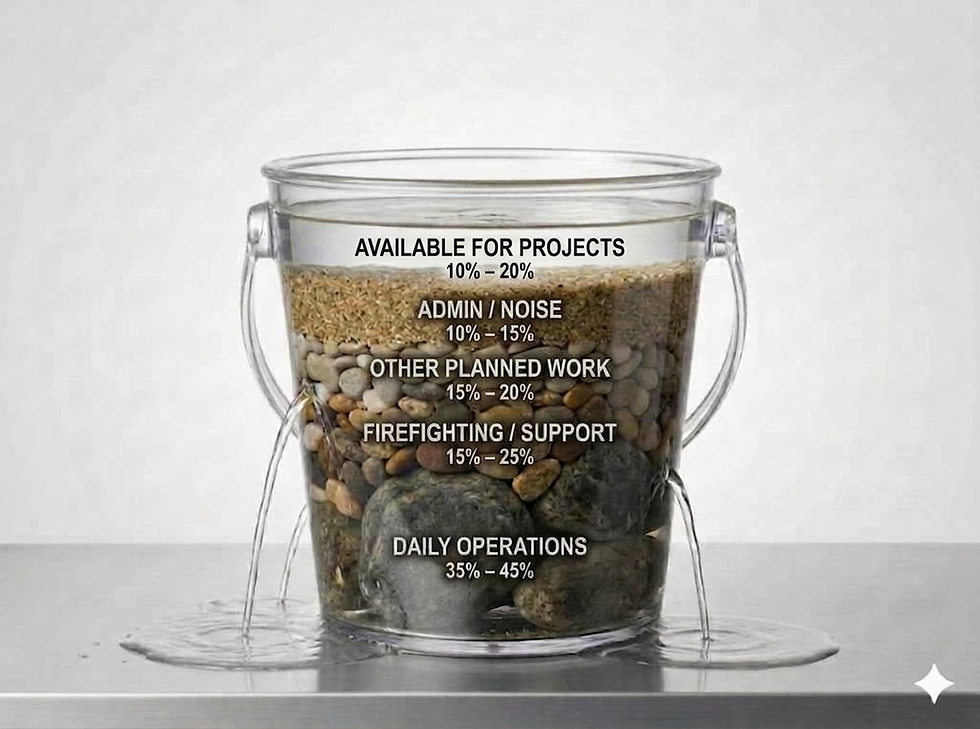
You’d see that it’s already filled with stones and gravel, representing:
Daily operations — 35–45%
Firefighting / support — 15–25%
Other planned work — 15–20%
Admin / noise — 10–15%
Available for projects — maybe 10–20%
These percentages are rough averages, and your mileage will vary. But the pattern is familiar: by the time you get to “available for projects,” there isn’t much bucket left.
This is where the real problem lies.
Most organizations think they have a capacity problem, when in reality they have a demand problem. They plan as if they’re starting from an empty bucket—or worse, as if they have an infinite supply of buckets. Then when the bucket overflows or springs leaks, they wonder why everything feels chaotic and projects go awry.
If we step back, the situation looks more like this:
We treat all incoming work as if it deserves a place in the bucket.
We rarely have a single, shared view of all demand competing for people’s time.
We underestimate how much capacity is already committed before we add “just one more project.”
That’s why visibility is the first step. Before we can “fix capacity,” we need to see all the stones in one place.
So what can we do if adding more buckets or turning the faucet down to a trickle is not an option?
The essential question becomes:
How do we optimize the capacity we already have and prioritize demand so the right work fits into the bucket?
For most organizations, that means:
Making current demand visible and comparable.
Protecting capacity for truly strategic work.
Being explicit about which stones can be removed, deferred, or resized.
This is exactly what my Capacity Quadrant framework is designed to address. It brings together four lenses—Visibility, Prioritization, Optimization, and Alignment—to help organizations balance demand and capacity without pretending the bucket is empty or that they can magically create infinite buckets.
The next challenge is not just deciding which work deserves space, but also which work is most important in the grand scheme. That importance determines who gets dibs on constrained resources, what gets scheduled first, and what can safely wait.
In my next post, I'll focus on prioritization. I’ll explore how strategic alignment, project scoring, and categorization work together as lenses for assigning a priority band to each initiative—so we’re not just filling the bucket, we’re filling it with the right work, in the right order.
In the meantime, if you’d like a deeper explanation of the symptoms of over‑commitment and hidden demand and how the Capacity Quadrant addresses them, you can:
Read the overview on my Strategic Advisory page.
Watch a recorded webinar walk‑through in this Project Guru Academy LinkedIn Live session I did with Dawn Mahan.

Comments